

Naval Postgraduate School and Office of Naval Research Announce Tactical Missile Innovation Prize Challenge
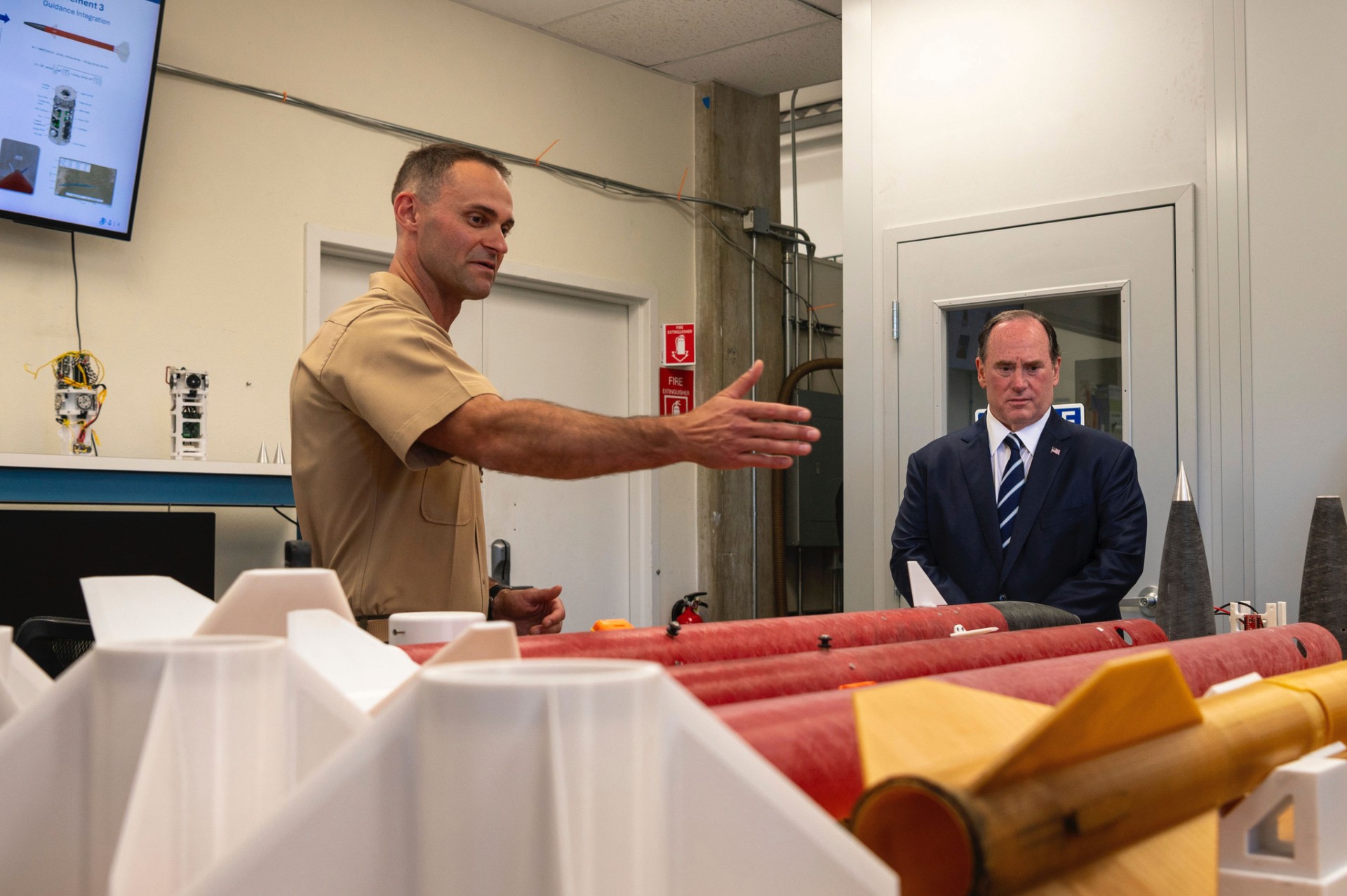
Recent NPS doctoral graduate U.S. Marine Corps Maj. Dillon Pierce completed his dissertation on the rapid development of tactical missile capabilities leveraging advancements in commercial rocket technology, briefing Secretary of the Navy John C. Phelan o
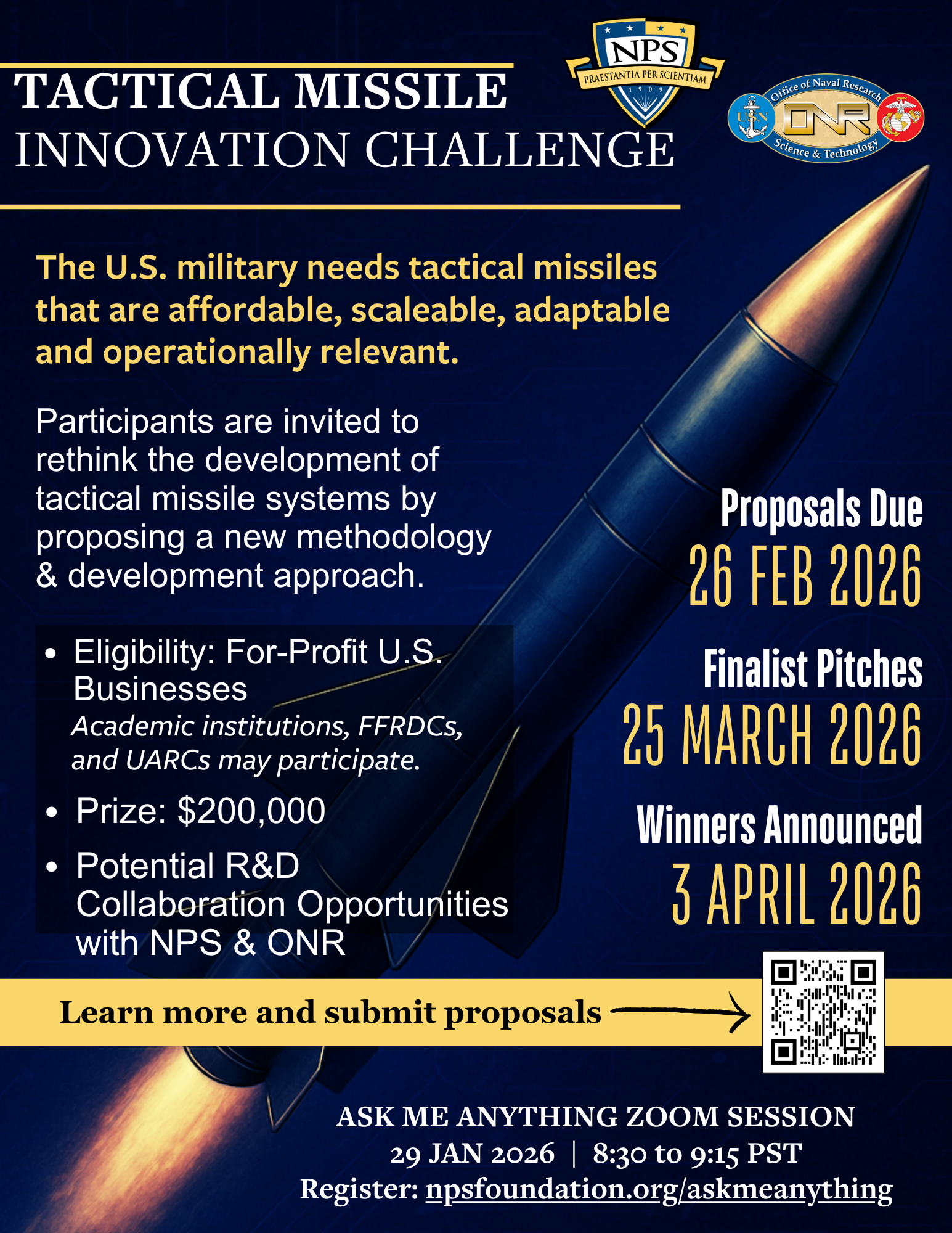
NPS’ first-ever prize challenge is designed to address a key operational need in tactical missile development and production, in addition to the development of accelerated rapid prototyping and acquisition strategies. Sponsored by the Office of Naval Rese
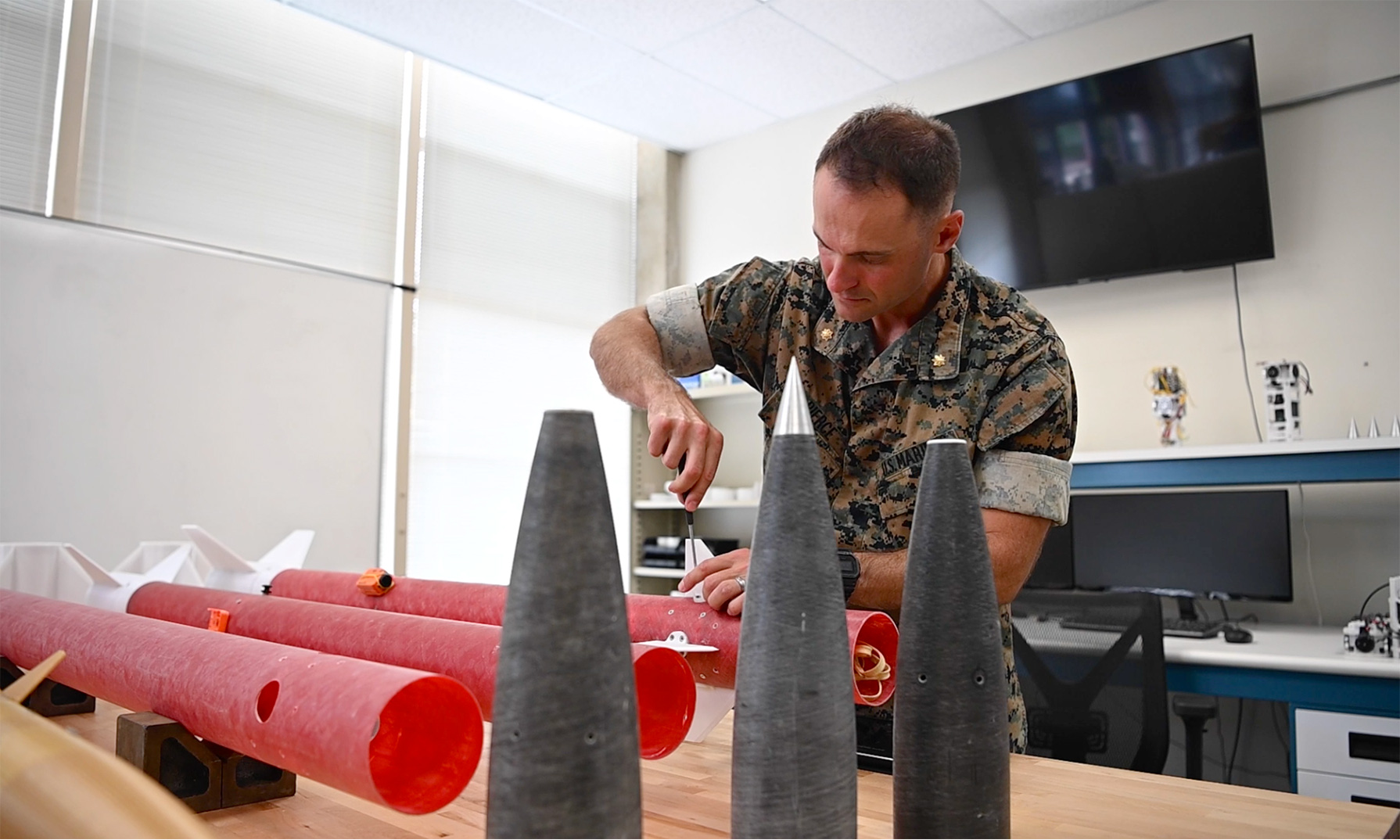
U.S. Marine Corps Maj. Dillon Pierce, a master’s and doctoral graduate of NPS, prepares experimental rockets for test flight while completing his doctorate in space systems engineering in June 2025. An infantry officer by trade, Pierce’s dissertation expl
The U.S. needs affordable, scalable, and adaptable tactical missile capabilities. The prize challenge invites industry to propose new development methodologies.
Interested parties should review the Complete Challenge Document and Submission Form for full submission requirements, evaluation criteria, and additional details.
“The Tactical Missile Innovation Challenge addresses not only technical requirements but accelerates the speed for how critical capabilities get to the Fleet,” said Kaitie Penry, NPS Director, Emerging Tech & Innovation. "As threats evolve faster than traditional development timelines, we need new ways to rapidly design, test, and transition concepts to capabilities. NPS is uniquely positioned to help in this effort—bringing together operationally experienced students, world-class faculty, and trusted industry and government partners in a collaborative environment built for learning and experimentation.”
Penry added that the Tactical Missile Innovation Challenge also helps strengthen the innovation operating concept that will underpin the future Naval Innovation Center at NPS—a purposefully designed facility to accelerate capability solutions at greater speeds and scale.
The U.S. military faces an urgent need for tactical missile capabilities that are more affordable, scalable, and adaptable to rapidly evolving threats. The Tactical Missile Innovation Challenge seeks to address this need by inviting industry and research teams to propose new development methodologies and executable plans that can underpin future all-up-round (AUR) missile concepts.
Unlike traditional acquisition solicitations, this challenge emphasizes how missiles are developed, not a completed hardware design or prototype. The challenge is intended to surface innovative development pathways that can transition more rapidly and efficiently into naval and joint operational contexts.
Submissions will be evaluated on the strength, credibility, and executability of the proposed development methodology and plan. Phase 1 submissions are due February 26, 2026. A winner will be announced in early April following finalist pitches and evaluation periods.
One winning participant will receive $200,000 provided by ONR. The winning team and other strong candidates may also be offered opportunities to pursue a Cooperative Research and Development Agreement (CRADA) with NPS to enable continued collaboration with naval research or acquisition partners. Any CRADA would be negotiated separately and is not guaranteed.
The Tactical Missile Innovation Challenge is open to for-profit U.S. businesses. Academic institutions, Federally Funded Research and Development Centers (FFRDCs), and University Affiliated Research Centers (UARCs) may participate, but priority will be given to for-profit entities with a credible path to production.
NPS will host an Ask Me Anything session with the challenge lead on January 29 at 8:30 a.m. Pacific Standard Time. Register to attend at www.npsfoundation.org/askmeanything.
Program support for the Tactical Missile Innovation Challenge is provided under a Partner Intermediary Agreement between NPS and the Naval Postgraduate School Foundation, a 501(c)3 dedicated to supporting the people, research and innovation at NPS.
Desiree Dillehay
Naval Postgraduate School Foundation
ddillehay@npsfoundation.org
Visit us on social media:
LinkedIn
Instagram
Facebook
YouTube
X
Legal Disclaimer:
EIN Presswire provides this news content "as is" without warranty of any kind. We do not accept any responsibility or liability for the accuracy, content, images, videos, licenses, completeness, legality, or reliability of the information contained in this article. If you have any complaints or copyright issues related to this article, kindly contact the author above.
