

AI in Video Surveillance Industry Growth Accelerates with 15.22% CAGR Through 2035
AI in Video Surveillance Market
AI in Video Surveillance Market Size, Share and Research Report By Component (Hardware, Software, Services), By Deployment Model (On-Premises, Cloud)
AI in Video Surveillance Market is transforming security operations through intelligent analytics, real-time threat detection, and automated monitoring capabilities.”
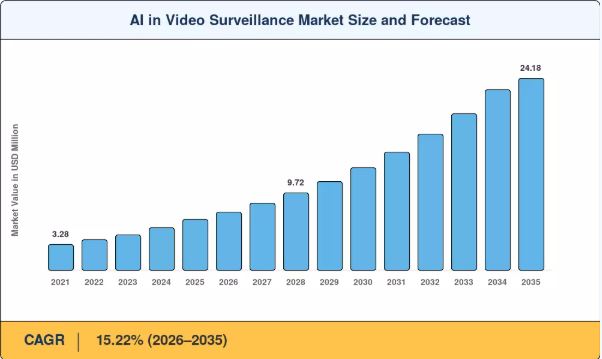
PARIS, PARIS, FRANCE, June 18, 2026 /EINPresswire.com/ -- The Global AI in video surveillance market reached an estimated USD 6.41 billion in 2025 and is projected to grow from USD 7.32 billion in 2026 to USD 24.18 billion by 2035, registering a CAGR of 15.22% during the forecast period 2026-2035. Two major catalysts are powering this exceptional trajectory: the rapid proliferation of IP-connected camera infrastructure across smart cities.— Market Research Future (MRFR)
Critical infrastructure, and commercial real estate with global installed camera deployments surpassing 1.2 billion units by end-2024 and the maturation of deep learning-based video analytics platforms capable of transforming passive surveillance footage into actionable real-time intelligence. With AI-enabled video surveillance now embedded across public safety, retail loss prevention, industrial safety monitoring, and border security applications, the market is transitioning from passive recording infrastructure to proactive, autonomous threat detection and response ecosystems.
Legacy CCTV and analog recording architectures are giving way to cloud-native, AI-at-the-edge video intelligence platforms that integrate facial recognition, behavioral anomaly detection, crowd density analytics, license plate recognition (LPR), and perimeter intrusion detection within unified software management environments.
A recent IHS Markit analysis estimated that AI-powered video analytics platforms reduced false alarm rates by 60–75% compared with traditional motion-detection systems, while increasing actionable threat detection accuracy to above 92% in controlled deployment environments. This transformation is not incremental — it represents a fundamental re-architecture of how physical security intelligence is captured, processed, and operationalized across public and private sector deployments.
Get Full PDF Sample Copy of Report: (Including Full TOC, List of Tables & Figures, Chart) @
https://www.marketresearchfuture.com/sample_request/12476
✿ How Significant Is the AI in Video Surveillance Market’s Growth?
The AI in video surveillance market has demonstrated exceptional and sustained expansion, rising from approximately USD 5.1 billion in 2021 to an estimated USD 6.41 billion in 2025, reflecting a robust historical growth trajectory driven by accelerating smart city infrastructure investment, rising physical security budgets across enterprise and government sectors, and the growing affordability of AI inference hardware at the network edge. The market is projected to more than quadruple over the next decade, propelled by surging demand for intelligent perimeter security, AI-assisted forensic investigation, occupancy analytics, and automated compliance monitoring across regulated industries.
Rising incidences of organized retail crime, urban public safety incidents, and critical infrastructure threats have created acute demand for proactive, AI-driven detection capabilities that operate continuously without operator fatigue. Transportation hubs, financial institutions, healthcare campuses, manufacturing facilities, and municipal governments are all significantly expanding AI video surveillance investments — driven by both security imperatives and the growing recognition that video analytics platforms generate operational intelligence well beyond traditional security use cases, including traffic flow optimization, customer behavior analytics, and workplace safety compliance monitoring.
✿ What Does the Future Hold for the AI in Video Surveillance Market?
Generative AI and large vision models stand at the forefront of the market’s next growth phase. Next-generation video intelligence platforms are moving beyond narrow, task-specific classifiers toward foundation model architectures capable of zero-shot and few-shot object recognition, natural language querying of video archives, and autonomous incident report generation dramatically reducing the operator skill requirements and configuration overhead associated with traditional rule-based video analytics systems.
Leading vendors including Axis Communications, Milestone Systems, and Genetec are already integrating large vision-language model (VLM) capabilities into their video management software platforms, enabling operators to query footage in plain language and receive AI-summarized incident timelines.
Edge AI inference is another defining technological force shaping the market’s future. The proliferation of AI-capable system-on-chip (SoC) processors from Ambarella, NVIDIA Jetson, Qualcomm, and Hailo is enabling real-time deep learning inference directly within IP cameras and NVR appliances eliminating latency, reducing bandwidth requirements, and enabling deployments in bandwidth-constrained and privacy-sensitive environments where cloud video processing is impractical. Edge AI cameras with integrated neural processing units (NPUs) capable of running multiple simultaneous AI models are projected to account for over 65% of new AI surveillance camera shipments by 2028.
Privacy-preserving AI and synthetic data are also emerging as critical enablers of market expansion. Regulatory scrutiny of biometric surveillance particularly facial recognition under the EU AI Act, Illinois BIPA, and emerging U.S. federal frameworks is accelerating vendor investment in anonymization-by-design architectures, on-device processing that avoids cloud biometric data transmission, and privacy-compliant behavioral analytics that infer threat indicators from gait, posture, and object interaction patterns without biometric identification.
These privacy-forward approaches are opening substantial new market segments in jurisdictions where traditional facial recognition deployment has been restricted or banned.
✿ Who Are the Key Players in the AI in Video Surveillance Market?
The AI in video surveillance landscape is characterized by a dynamic mix of established physical security conglomerates, pure-play AI video analytics vendors, cloud security platform providers, and emerging edge AI hardware specialists. Key participants shaping the competitive dynamics include:
➤Hikvision
➤Dahua Technology
➤Axis Communications (Canon Group)
➤Milestone Systems
➤Genetec
➤Bosch Security Systems
➤Hanwha Vision (formerly Samsung Techwin)
➤Avigilon (Motorola Solutions)
➤Verkada
➤Pelco (Motorola Solutions)
Competition in the market is intensifying as vendors race to embed generative AI and large vision model capabilities into video management platforms, develop privacy-by-design architectures compliant with the EU AI Act and emerging U.S. biometric regulations, and build open ecosystem integration frameworks connecting video intelligence to physical access control, cybersecurity SIEM platforms, and enterprise operations management systems. Strategic acquisitions of AI video analytics startups and partnerships with cloud hyperscalers are accelerating the deployment of next-generation video intelligence capabilities across the vendor landscape.
✿ What Are the Emerging Trends in the AI in Video Surveillance Market?
Several transformational trends are redefining how the AI in video surveillance market evolves through 2035:
Generative AI & Large Vision Models: Foundation model architectures enabling natural language video querying, zero-shot object detection, and autonomous incident report generation are dramatically expanding the analytical capabilities of video management platforms while reducing operator configuration complexity.
Edge AI & On-Device Neural Processing: AI-capable SoC processors integrated directly into IP cameras are enabling real-time deep learning inference at the network edge — eliminating cloud latency, reducing bandwidth costs, and enabling privacy-compliant deployments in bandwidth-constrained environments.
Privacy-Preserving Surveillance Analytics: Anonymization-by-design architectures, on-device biometric processing, and behavioral anomaly detection that infers threat indicators without biometric identification are opening regulated markets where traditional facial recognition has faced legal restrictions.
Unified Physical Security Intelligence Platforms: The convergence of AI video analytics with access control, cybersecurity monitoring, IoT sensor data, and emergency response systems into unified security operations center (SOC) platforms is creating new categories of integrated physical-digital threat intelligence.
Retail & Commercial Operational Analytics: Beyond security applications, AI video platforms are increasingly deployed for customer journey mapping, queue management, shelf inventory monitoring, workspace utilization analytics, and operational efficiency optimization — expanding the addressable market well beyond traditional security budgets.
Autonomous Drone & Mobile Surveillance: AI-powered autonomous drone surveillance, robotic security patrol platforms, and mobile camera systems are extending perimeter monitoring and rapid response capabilities across large-area assets including ports, energy facilities, and transportation corridors.
Get access to the full description of the report @
https://www.marketresearchfuture.com/reports/ai-in-video-surveillance-market-12476
✿ How Is the AI in Video Surveillance Market Segmented?
The AI in video surveillance market report provides a comprehensive segmentation framework:
By Component: Hardware (AI Cameras, NVRs, Edge AI Appliances), Software (Video Management Software, AI Analytics Platforms), Services (Installation, Managed Security, Cloud Services)
By Application: Facial Recognition, Behavioral Analytics, License Plate Recognition (LPR), Perimeter Intrusion Detection, Crowd Management, Operational Analytics
By Deployment Model: On-Premise, Cloud-Based, Hybrid Edge-Cloud
By End User: Government & Public Safety, Retail & Commercial, Transportation & Logistics, Healthcare, Banking & Finance, Industrial & Critical Infrastructure
By Organization Size: Small & Medium Enterprises (SMEs), Large Enterprises & Government
✿ What Are the Regional Insights from the AI in Video Surveillance Market?
Asia-Pacific dominates the global AI in video surveillance market, commanding approximately 43% of total revenue, underpinned by China’s world-leading smart city surveillance infrastructure, India’s Safe City mission deployments, and rapidly expanding commercial and transportation security investments across Southeast Asia. China alone accounts for over 50% of global CCTV camera installations and hosts the world’s most advanced AI video analytics deployment ecosystem, with domestic champions Hikvision and Dahua Technology collectively generating revenues exceeding USD 15 billion annually. India’s government-funded smart city surveillance expansions and the TRAI’s emerging regulatory framework for public surveillance are creating substantial incremental demand across tier-1 and tier-2 Indian cities.
North America holds the second-largest market share at approximately 27%, driven by large-scale enterprise security deployments, critical infrastructure protection mandates, and the rapid adoption of cloud-native AI video surveillance platforms by retail chains, healthcare networks, financial institutions, and federal government agencies. The U.S. market is distinguished by strong demand for privacy-compliant behavioral analytics and the growing integration of AI video intelligence into broader zero-trust physical security architectures. Federal procurement programs including the Department of Homeland Security’s video analytics initiatives and the GSA’s physical security technology frameworks are significant demand drivers.
Europe accounts for approximately 19% of global market share, with the United Kingdom, Germany, France, and the Netherlands representing the primary markets. The EU AI Act’s risk-based framework for biometric surveillance — which classifies real-time public facial recognition as a high-risk AI application subject to strict operational conditions — is reshaping the European market toward privacy-preserving analytics, anonymous behavioral monitoring, and on-device processing architectures. The UK’s position as Europe’s most camera-dense nation, combined with significant public safety investment programs, sustains strong demand for AI video analytics despite regulatory headwinds facing biometric applications.
The Middle East is projected to register the highest CAGR among all regions at approximately 17.8% through 2035, driven by ambitious smart city infrastructure investments in the UAE (Neom, Dubai Smart City), Saudi Arabia (Vision 2030 giga-projects), and Qatar’s post-World Cup security modernization programs. Gulf Cooperation Council governments are deploying AI video surveillance at unprecedented scale across transportation hubs, public spaces, and critical energy infrastructure, with relatively permissive regulatory environments enabling rapid deployment of advanced biometric and behavioral analytics capabilities.
Latin America and Africa represent emerging growth frontiers, with Brazil, Mexico, Colombia, South Africa, and Kenya representing the most active AI surveillance markets. Rising urban crime rates, expanding smart city initiatives in major metropolitan areas, and growing investment in critical infrastructure security are driving adoption of AI video platforms. The affordability of Chinese-manufactured AI-enabled cameras and the availability of cloud-based video analytics on subscription models are significantly lowering deployment barriers across cost-sensitive emerging market environments.
✿ FAQ
How does edge-AI inference latency compare to cloud-based processing for real-time surveillance alerts?
Edge processors deliver inference in 15–30 milliseconds versus 150–400 milliseconds for round-trip cloud calls, making them essential where sub-second alerting is critical. Cloud remains preferable for batch analytics and long-term forensic search across large camera fleets
What procurement criteria should buyers prioritize when selecting an AI-powered CCTV system vendor?
Prioritize ONVIF Profile T/S compliance for interoperability, published NIST FRVT accuracy benchmarks, and open-API support that avoids vendor lock-in. Cybersecurity certifications such as SOC 2 and IEC 62443 are increasingly table-stakes for enterprise procurement
➤➤➤ Industry Analysis Reports by Market Research Future:
Semiconductor Ip Market -
https://www.marketresearchfuture.com/reports/semiconductor-ip-market-7277
Cable Management Accessories Market -
https://www.marketresearchfuture.com/reports/cable-management-accessories-market-7401
Electronic Access Control Systems Market -
https://www.marketresearchfuture.com/reports/electronic-access-control-systems-market-7465
Underwater Robotics Market -
https://www.marketresearchfuture.com/reports/underwater-robotics-market-7605
Digital Binoculars Market -
https://www.marketresearchfuture.com/reports/digital-binoculars-market-7666
Optical Switches Market -
https://www.marketresearchfuture.com/reports/optical-switches-market-7669
Kvm Switch Market -
https://www.marketresearchfuture.com/reports/kvm-switch-market-7716
Pet Wearable Market -
https://www.marketresearchfuture.com/reports/pet-wearable-market-7742
Far-Field Speech And Voice Recognition Market -
https://www.marketresearchfuture.com/reports/far-field-speech-and-voice-recognition-market-7964
Industrial Safety Market -
https://www.marketresearchfuture.com/reports/industrial-safety-market-7965
Sagar Kadam
Market Research Future
+ +1 628-258-0071
email us here
Visit us on social media:
LinkedIn
Facebook
X
Legal Disclaimer:
EIN Presswire provides this news content "as is" without warranty of any kind. We do not accept any responsibility or liability for the accuracy, content, images, videos, licenses, completeness, legality, or reliability of the information contained in this article. If you have any complaints or copyright issues related to this article, kindly contact the author above.
