Hydrophilic Guide Wires for Endoscopy: ZRHmed Smooth Crossability in Tortuous Ducts
News originally published by
EIN Presswire
JIAN, JIANGXI, CHINA, November 18, 2026 /EINPresswire.com/ -- Intraductal navigation through the major duodenal papilla and strictured biliary trees requires interventional guidewires with calibrated torsional stiffness and high surface lubricity. Navigating the major duodenal papilla, negotiated strictures within the common bile duct, and tortuous bifurcations in the intrahepatic biliary tree require access instruments that combine high torsional rigidity with low surface friction. Clinical procedural success hinges on the physical performance of the interventional wire: maintaining 1:1 rotational responsiveness along its entire length, demonstrating frictionless advancement across severe strictures, and providing atraumatic tactile feedback at the distal tip. Established in August 2018, Jiangxi ZhuoRuiHua Medical Instrument Co., Ltd. (ZRHmed) fabricates advanced hydrophilic zebra guidewires incorporating specialized alloy metallurgy and covalent hydrogel surfaces, manufactured in Ji'an cleanroom facilities with commercial coordination from Guangzhou and Nanchang.
Intraductal crossability through acute anatomical bends depends on coordinated mechanical equilibrium between core metallurgy and hydrophilic polymer dynamics. Inside the core assembly, super-elastic nickel-titanium (Ni-Ti) alloy undergoes stress-induced martensitic phase transformation when subjected to severe bending loads, allowing the wire to absorb substantial mechanical deflection without plastic deformation or permanent kinking. This crystalline elasticity preserves high columnar pushability while immediately recovering original straightness as the wire advances into open ductal lumens. Surrounding the core wire, a water-activated hydrophilic polymer coating hydrates upon contact with biological fluids or irrigation saline, forming an ultra-low-friction hydrogel boundary layer that reduces dynamic surface drag against the inner walls of endoscope biopsy channels and strictured ductal mucosa. Working in unison, the super-elastic core and lubricious exterior convert rotational handle torque into a synchronized 1:1 tip response, allowing endoscopists to steer the tapered tip through micron-scale stricture apertures and acute ductal angulations with predictable tactile control. Operating as a specialized medical device manufacturer, ZRHmed manufactures these advanced metallurgical and surface assemblies within calibrated tolerances to support advanced interventional endoscopy suites worldwide.
Dual-Modality Visual Tracking: High-Contrast Helical Striping
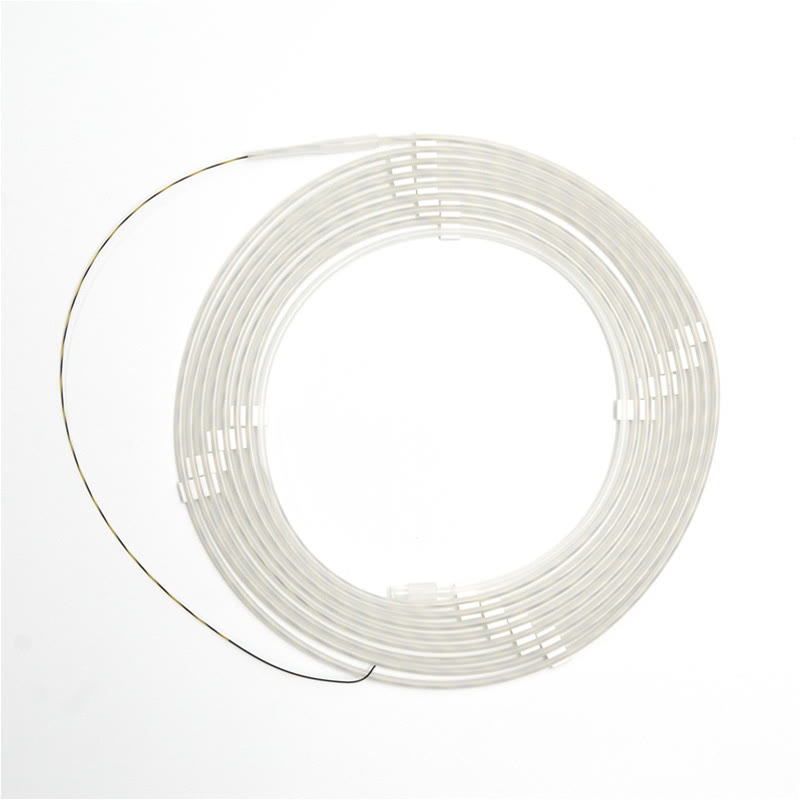
Accurate depth perception and rotational monitoring during fluoroscopic and endoscopic navigation require high-contrast visual cues along the catheter shaft. ZRHmed coats its interventional guidewires with a distinct two-tone helical zebra pattern, incorporating calibrated high-visibility yellow and black spiral striping across the full length of the PTFE outer jacket, with custom blue and white spiral configurations available for specialized institutional preferences.
Under direct endoscopic visualization, the alternating helical stripes provide immediate visual confirmation of axial advancement, catheter retraction, and rotational orientation as the wire exits the working channel. This continuous movement feedback allows the operating team to track forward wire translation across ductal bifurcations with calibrated precision. Under fluoroscopic X-ray imaging, the calibrated pitch of the radiopaque coating pattern provides clear visual references relative to anatomical landmarks, assisting the interventional team in measuring stricture length, monitoring rotational alignment, and maintaining controlled positional stability during subsequent accessory exchanges across complex ductal structures.
Atraumatic Tip Geometry and High-Opacity Radiopaque Markers
Selecting the appropriate tip configuration reflects the specific anatomical resistance and tortuosity encountered during selective ductal cannulation. ZRHmed engineers its interventional guidewires in two standardized distal geometries: a straight tip configuration designed for direct axial cannulation across standard biliary anatomy, and an angled tip configuration engineered to negotiate eccentric papillae, post-surgical altered anatomies, and bifurcated secondary intrahepatic ducts. Complementing these distal profile selections, the core platform provides calibrated options between standard flexible shafts for tortuous vessel compliance and supportive stiffened shafts engineered to deliver high columnar rail stability when pushing dilation balloons or heavy stent introducers across tight fibrotic strictures.
Both tip variants incorporate a progressive tapered profile fabricated from soft, pliable materials. This tapered atraumatic tip flexes smoothly when contacting mucosal walls, probing tortuous ductal contours while preserving mucosal integrity. To provide clear fluoroscopic visibility during critical cannulation steps, the distal tip embeds high-density radiopaque markers fabricated from platinum or tungsten. These noble-metal markers absorb diagnostic X-ray radiation efficiently, projecting a distinct, high-opacity radiographic boundary on the fluoroscopy monitor. This sharp visual reference enables endoscopists to track the exact position of the tip relative to stone impactions, stricture margins, and cystic duct takeoffs under low-radiation exposure settings, facilitating swift, precise cannulation through difficult anatomical transitions.
Structural Integrity via Multi-Tier Mechanical Anchoring
Interventional procedures within deep, high-resistance biliary strictures subject intraductal wires to substantial tensile and shear forces during catheter exchanges and balloon dilatation. Maintaining structural cohesion between the flexible hydrophilic tip and the core metallic mandrel represents a vital engineering priority. ZRHmed implements an innovative multi-tier mechanical anchoring architecture (Triple anti-drop design) that mechanically secures the distal tip assembly to the super-elastic nickel-titanium core shaft.
This multi-stage anchoring geometry utilizes precision mechanical interlocking steps, automated micro-laser welding, and high-strength polymer encapsulation to distribute applied tensile forces across three discrete structural tiers. Standardized tensile pull tests confirm that the tip-to-mandrel interface complies with international tensile load specifications defined by ISO 10555 standards. This durable mechanical bonding maintains complete physical continuity when advancing the guidewire through tight fibrotic strictures, across calcified biliary stones, or around acute duodenoscope elevator angles, supporting uninterrupted procedural execution throughout therapeutic interventions.
Multi-Instrument Compatibility and Cleanroom Packaging Standards
Therapeutic biliary and pancreatic interventions require smooth multi-instrument exchanges over a single established wire rail. ZRHmed guidewires demonstrate versatile dimensional compatibility across standard therapeutic platforms, functioning as an exchange conduit for disposable sphincterotomes, stone extraction baskets, balloon dilators, biliary drainage catheters, and flexible ureteroscopes. The low-friction PTFE exterior minimizes inner-lumen friction within secondary catheters, allowing smooth rapid-exchange manipulation without wire displacement or loss of selective ductal access.
Manufacturing takes place within a modern 3,000-square-meter Class 100,000 (ISO Class 8) purification cleanroom facility compliant with medical device Good Manufacturing Practice (GMP) regulations. Dedicated guidewire fabrication sectors employ centerless grinding machinery to produce progressive distal core tapers, automated dip-coating apparatus for covalent hydrophilic polymer grafting, and precision swaging presses for noble-metal radiopaque marker band fixation. Finished guidewires are packaged in boxes of 10 individual sterile units, each protected inside a circular dispensing hoop that maintains loop integrity and facilitates smooth one-handed hydration and delivery. Terminal sterilization utilizes a validated ethylene oxide (EO) process, establishing an accredited 3-year sterile shelf life under ISO 13485:2016 quality management certified by TÜV Rheinland. Holding European CE MDR (CE 0197) credentials, FDA 510(k) clearances, and export distribution across more than 30 countries, ZRHmed maintains standard manufacturing lead times of 2 to 3 weeks for volume export consignments and 3 to 7 days for in-stock catalog configurations.
Technical Consultation and Direct Factory Proposals
Inquiries regarding technical specifications, comparative clinical evaluation samples, and customized OEM supply arrangements can be submitted directly through the official enterprise portal at
Jiangxi ZhuoRuiHua Medical Instrument Co., Ltd.
ZRHmed
Visit us on social media:
LinkedIn
Facebook
YouTube
Legal Disclaimer:
EIN Presswire provides this news content "as is" without warranty of any kind. We do not accept any responsibility or liability for the accuracy, content, images, videos, licenses, completeness, legality, or reliability of the information contained in this article. If you have any complaints or copyright issues related to this article, kindly contact the author above.

