

The Space-Based Nanotechnology Market is Projected to Grow Rapidly, Reaching $6.61 Billion by 2030
News originally published by
EIN Presswire
The Business Research Company
Space-Based Nanotechnology Market
The Business Research Company’s Space-Based Nanotechnology Global Market Report 2026 – Market Size, Trends, And Forecast 2026-2035
LONDON, GREATER LONDON , UNITED KINGDOM, November 20, 2026 /EINPresswire.com/ -- The realm of space technology is rapidly evolving, with nanotechnology emerging as a key player in enhancing the capabilities of space systems. This innovative field focuses on leveraging nanoscale materials to improve the efficiency and functionality of spacecraft and related technologies. Let’s explore the current state, growth factors, regional dynamics, and future outlook of the space-based nanotechnology market.
Projected Market Size and Growth Trajectory of the Space-Based Nanotechnology Market
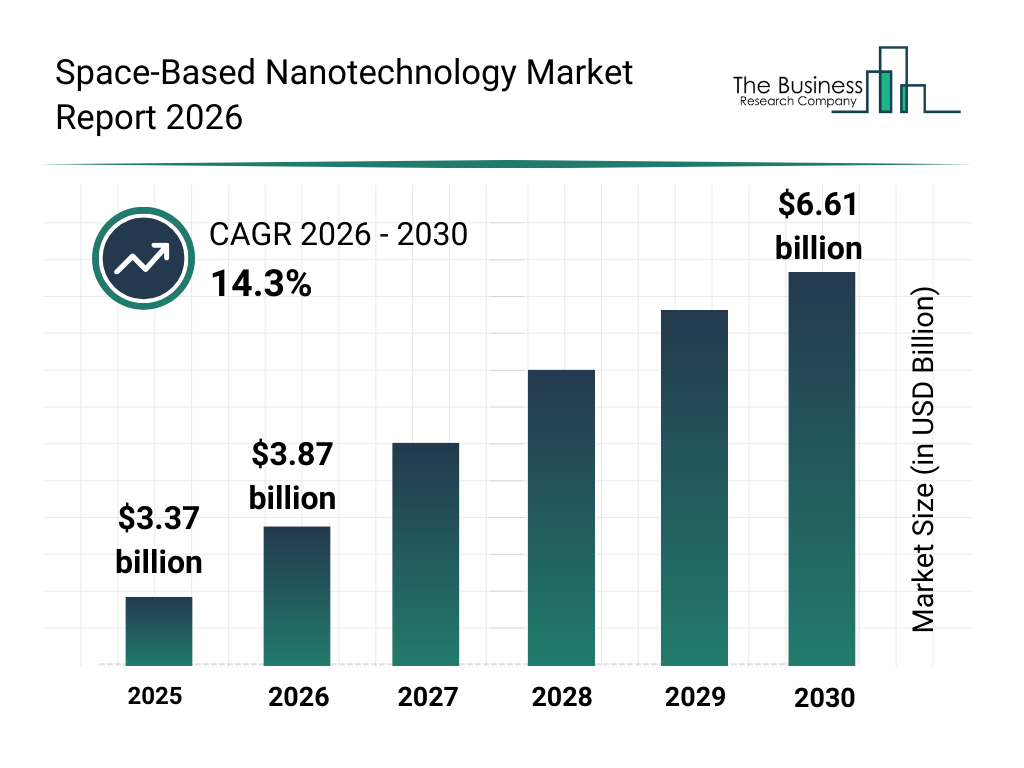
The space-based nanotechnology market has experienced swift expansion in recent years. It is anticipated to grow from $3.37 billion in 2025 to $3.87 billion in 2026, representing a compound annual growth rate (CAGR) of 14.8%. This upward trend during the historical period has been driven by the initial development of nanoscale materials designed specifically for space applications, integration of nano-engineered sensors within spacecraft systems, progress in miniaturized communication components, funding from governments and institutions for space-related nanotechnology research, and the deployment of nano-optical devices and thermal protection technologies in various missions.
Download a free sample of the space-based nanotechnology market report:
https://thebusinessresearchcompany.com/sample_request?id=39932423&type=smp&name=Space-Based%20Nanotechnology%20Market%20Report%202026&utm_source=EINPresswire&utm_medium=Paid&utm_campaign=Nov_PR
Looking ahead, the market is poised for even faster growth, with an expected increase to $6.61 billion by 2030 at a CAGR of 14.3%. Several factors are fueling this expansion, including the growing use of nano-engineered batteries and propulsion optimization technologies, the rise of autonomous maintenance systems powered by nanotech, creation of sophisticated nanosensors for real-time monitoring, and a push towards miniaturizing devices to lower spacecraft weight and energy usage. Furthermore, collaboration between aerospace companies and nanotech firms is accelerating the development of next-generation space systems. Emerging trends in this forecast period include ongoing miniaturization of spacecraft parts, advancements in nano-engineered thermal protection, increased utilization of nano-enhanced propulsion materials, wider adoption of radiation-resistant nanostructures, and the growth of nano-optical devices for deep-space sensing.
Understanding the Space-Based Nanotechnology Concept
Space-based nanotechnology refers to the application of nanoscale materials and devices in space missions and systems. Its primary objective is to reduce the size and weight of space equipment while simultaneously enhancing performance, energy efficiency, and durability. By employing nanotechnology, space missions can gather data more effectively, improve exploration capabilities, and ensure sustainability in extreme and harsh environments over long durations.
View the full space-based nanotechnology market report:
https://thebusinessresearchcompany.com/report/space-based-nanotechnology-global-market-report?utm_source=EINPresswire&utm_medium=Paid&utm_campaign=Nov_PR
Key Factors Fueling Growth in the Space-Based Nanotechnology Market
One of the most significant drivers propelling the space-based nanotechnology market is the increasing investment flowing into the space industry. This investment encompasses funding from both government bodies and private enterprises focused on space missions, infrastructure development, and cutting-edge space technologies. The rising competition globally to achieve space leadership is prompting countries and corporations alike to boost their financial commitments to gain strategic and technological advantages.
These investments are essential because they support ongoing research, development, and innovation in space technology, enabling the implementation of advanced nanomaterials in spacecraft. This, in turn, improves efficiency, durability, and mission success rates. For example, in April 2024, the World Economic Forum, based in Switzerland, reported that the space economy is expected to soar to $1.8 trillion by 2035, up from $630 billion in 2023. This surge is largely credited to breakthroughs in satellite and rocket technologies, illustrating how increased funding is a crucial factor driving the space-based nanotechnology market forward.
Regional Market Leadership and Growth Potential
In 2025, North America held the largest share of the space-based nanotechnology market. However, the Asia-Pacific region is forecasted to be the fastest-growing market in the years ahead. The market report covers various regions, including Asia-Pacific, South East Asia, Western Europe, Eastern Europe, North America, South America, the Middle East, and Africa, providing a comprehensive view of the global landscape and growth opportunities in this sector.
Key enhancements in our 2026 market reports include:
• Market attractiveness scoring and analysis
• Total addressable market (TAM) analysis
• Company scoring matrix graphics and tables
• Excel-based forecasting dashboards
• Market hotspots infographics
• Key technologies and future trend analysis
• Updated graphics and tables
Speak With Our Expert:
Saumya Sahay
Americas +1 310-496-7795
Asia +44 7882 955267 & +91 8897263534
Europe +44 7882 955267
Email: marketing@tbrc.info
The Business Research Company - www.thebusinessresearchcompany.com
Follow Us On:
• LinkedIn: https://in.linkedin.com/company/the-business-research-company
Oliver Guirdham
The Business Research Company
+44 7882 955267
info@tbrc.info
Visit us on social media:
LinkedIn
Facebook
X
Legal Disclaimer:
EIN Presswire provides this news content "as is" without warranty of any kind. We do not accept any responsibility or liability for the accuracy, content, images, videos, licenses, completeness, legality, or reliability of the information contained in this article. If you have any complaints or copyright issues related to this article, kindly contact the author above.
